

Conveyancing Costs in Cape Town: What Sellers and Buyers Pay
What a transfer costs in Cape Town: transfer duty, legal fees, Deeds Office fees and bond costs explained.
Conveyancing costs Cape Town sellers and buyers pay fall on both sides of the deal. The seller and the buyer each pay different items, and some of them are only worked out once the purchase price is known. This guide explains what each side typically pays, who the money goes to and how to avoid surprises. It forms part of our guide to the property transfer process in Cape Town.
At a glance: who pays what
| Cost | Usually paid by | Paid to |
|---|---|---|
| Estate agent commission | Seller | Estate agent (negotiated) |
| Bond cancellation costs | Seller | The conveyancer who cancels the bond |
| Compliance certificates and repairs | Seller (unless agreed otherwise) | Registered contractors |
| Rates and levy clearance amounts (the buyer usually refunds the pro-rata portion) | Seller | City of Cape Town, body corporate or homeowners' association |
| Transfer duty | Buyer | SARS, paid through the conveyancer |
| Conveyancing (transfer) legal fees | Buyer | The conveyancer |
| Deeds Office registration fees | Buyer | Deeds Office (government) |
| Bond registration costs (only if you take a bond) | Buyer | The bank's conveyancer and the Deeds Office |
| Bank initiation fee (only if you take a bond) | Buyer | Your bank |
Costs sellers pay
- Estate agent commission. This is negotiated with the agent and is normally a percentage of the selling price, plus VAT.
- Bond cancellation costs. If you still owe money on your bond, there are costs to cancel it at the Deeds Office.
- Compliance certificates. Electrical, water installation, gas, electric fence and beetle certificates are usually the seller's responsibility, along with any repairs needed to pass. See our guide to compliance certificates in Cape Town.
- Rates and levies. All municipal rates and, for sectional title or estates, levies must be paid up to date before the transfer can be lodged.
- Rates paid in advance. The seller pays rates in advance to obtain the rates clearance certificate from the City of Cape Town, so the amount paid can run past the date the transfer registers. The buyer usually refunds the seller the pro-rata portion for the period after registration.
Costs buyers pay
Transfer duty
Transfer duty is a tax paid to SARS on the purchase of property. It is calculated on a sliding scale, and no transfer duty is payable on a property up to R1 210 000. The rates below have applied since 1 April 2025 and SARS lists no changes for the 2026/27 tax year.
| Property value | Transfer duty |
|---|---|
| R1 to R1 210 000 | 0% |
| R1 210 001 to R1 663 800 | 3% of the value above R1 210 000 |
| R1 663 801 to R2 329 300 | R13 614 + 6% of the value above R1 663 800 |
| R2 329 301 to R2 994 800 | R53 544 + 8% of the value above R2 329 300 |
| R2 994 801 to R13 310 000 | R106 784 + 11% of the value above R2 994 800 |
| R13 310 001 and above | R1 241 456 + 13% of the value above R13 310 000 |
Worked examples
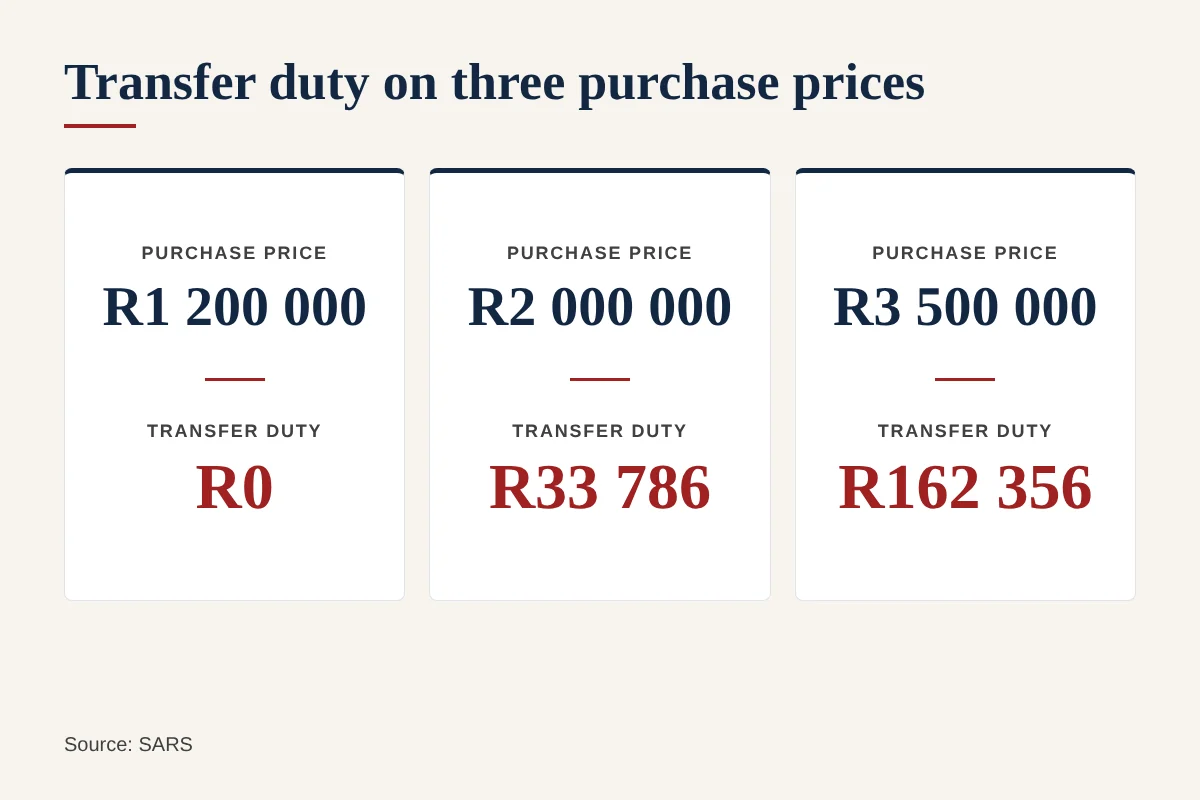
- A property bought for R1 200 000 attracts transfer duty of R0.
- A property bought for R2 000 000 attracts transfer duty of R33 786.
- A property bought for R3 500 000 attracts transfer duty of R162 356.
If the seller is a VAT vendor and VAT is charged on the sale, transfer duty is not payable. There is no separate exemption for first-time buyers, so the same threshold applies to every buyer.
Conveyancing (transfer) fees
These are the legal fees of the conveyancer who attends to the transfer. VAT is added on top, along with small out-of-pocket costs such as couriers and copies, which should be agreed with you in advance.
Deeds Office fees
The Deeds Office charges government registration fees that rise with the value of the property. The Deeds Office Schedule of Fees was amended by Government Notice No. 7180 of 27 February 2026 (Government Gazette No. 54225).
Bond registration costs
If you take a bond, there are legal fees for registering it and a separate Deeds Office fee. Both depend on the bond amount, as the estimates below show. Your bank may also charge an initiation fee, which is not part of the conveyancing costs.
Conveyancing costs Cape Town: estimated totals at different purchase prices
These are estimates only. The table shows what a buyer can expect to pay in transfer costs at four purchase prices. It uses the SARS transfer duty rates, the guideline transfer fee from the Law Society of South Africa (LSSA) 2026 guideline plus VAT at 15%, and the Deeds Office fee from the Schedule of Fees. Conveyancing fees are negotiable, so your own quote may differ.
| Purchase price | Transfer duty | Guideline transfer fee (incl. VAT) | Deeds Office fee | Estimated total |
|---|---|---|---|---|
| R1 500 000 | R8 700 | R37 530 | R1 738 | R47 968 |
| R2 500 000 | R67 200 | R49 720 | R2 408 | R119 328 |
| R3 500 000 | R162 356 | R61 910 | R2 408 | R226 674 |
| R5 000 000 | R327 356 | R78 976 | R2 922 | R409 254 |
Estimated bond registration costs. If you take a bond, add the costs below. They are worked out in the same way, using the LSSA 2026 guideline fee plus VAT at 15% and the Deeds Office bond registration fee, at each bond amount.
| Bond amount | Guideline bond registration fee (incl. VAT) | Deeds Office bond fee | Estimated total |
|---|---|---|---|
| R1 500 000 | R37 530 | R1 738 | R39 268 |
| R2 500 000 | R49 720 | R2 408 | R52 128 |
| R3 500 000 | R61 910 | R2 408 | R64 318 |
| R5 000 000 | R78 976 | R2 922 | R81 898 |
These estimates assume a single property and a straightforward matter, are rounded to the nearest rand, and do not include your bank's initiation fee or small out-of-pocket costs. Transfer duty is not payable if VAT is charged on the sale. For a figure that fits your matter, use our cost calculators or ask our legal team for a written quote.
Who sets conveyancing fees?
Conveyancing fees are not fixed by law. The Law Society of South Africa (LSSA) publishes an annual fee guideline, and the 2026 guideline took effect on 1 July 2026. It is a guide, not a rule: fees are negotiable and the guideline amounts exclude VAT. Fees follow a sliding scale, so they rise with the value of the property or the bond. Always ask for a written quote that sets out the fees, VAT and any other costs before you instruct a conveyancer.
The Law Society of South Africa (LSSA) is a voluntary professional body that publishes the guideline. Attorneys are regulated by the Legal Practice Council.
Budget with confidence
Costs depend on the purchase price, the bond amount and whether the property is freehold or sectional title. Use our cost calculators for an estimate, and speak to our legal team to confirm the figures for your matter.
Tips to avoid surprises
- Ask for a written quote early and check what is included.
- Budget for transfer duty, which is paid before the documents are lodged.
- Remember that municipal rates and levies may need to be paid in advance.
- Sellers: add certificate costs and any repairs to your budget.
- Buyers: keep funds for costs separate from your deposit and your bond.
Frequently asked questions
Who pays conveyancing fees, the seller or the buyer?
The buyer pays the transfer fees of the conveyancer who attends to the transfer. The seller pays estate agent commission, the costs of cancelling their bond and usually the cost of compliance certificates.
How much transfer duty will I pay in Cape Town?
It depends on the purchase price. No transfer duty is payable up to R1 210 000. Above that, SARS charges a sliding scale starting at 3% of the value above R1 210 000. For example, a property bought for R2 000 000 attracts transfer duty of R33 786.
Are conveyancing fees fixed?
No. The Law Society of South Africa (LSSA) publishes a fee guideline each year, but it is a guide and fees are negotiable. Guideline amounts exclude VAT and rise with the value of the property.
Do first-time buyers pay transfer duty?
Yes, if the property costs more than R1 210 000. There is no separate first-time buyer exemption, and the same threshold applies to every buyer.
Are bond registration costs included in the transfer fees?
No. Bond registration costs are separate and only apply if the buyer takes a bond. They include legal fees for registering the bond and a Deeds Office fee, both based on the bond amount.
Further reading from Cape Conveyancers
Our Cape Conveyancers articles cover related topics in more detail.
- How the 2026 Deeds Office fee changes affect you: the 2026 Deeds Office fee changes and what they mean for your transfer.
- Transfer costs versus bond costs: how transfer costs and bond registration costs differ.
Sources
- SARS: Transfer duty
- Law Society of South Africa (LSSA): Conveyancing Fee Guidelines 2026
- Deeds Office Schedule of Fees: Government Notice 7180 of 2026
This guide is general information, not legal advice. Every property matter is different, so please speak to our legal team about yours. Information correct at November 2026.
Speak to our legal team
Selling or buying in Cape Town and want clear answers before you sign? Our legal team is available, accountable and focused on moving your matter forward.
Book a consultation